Platform · Outreach
Engage customers before service gaps become complaints, churn or missed payments
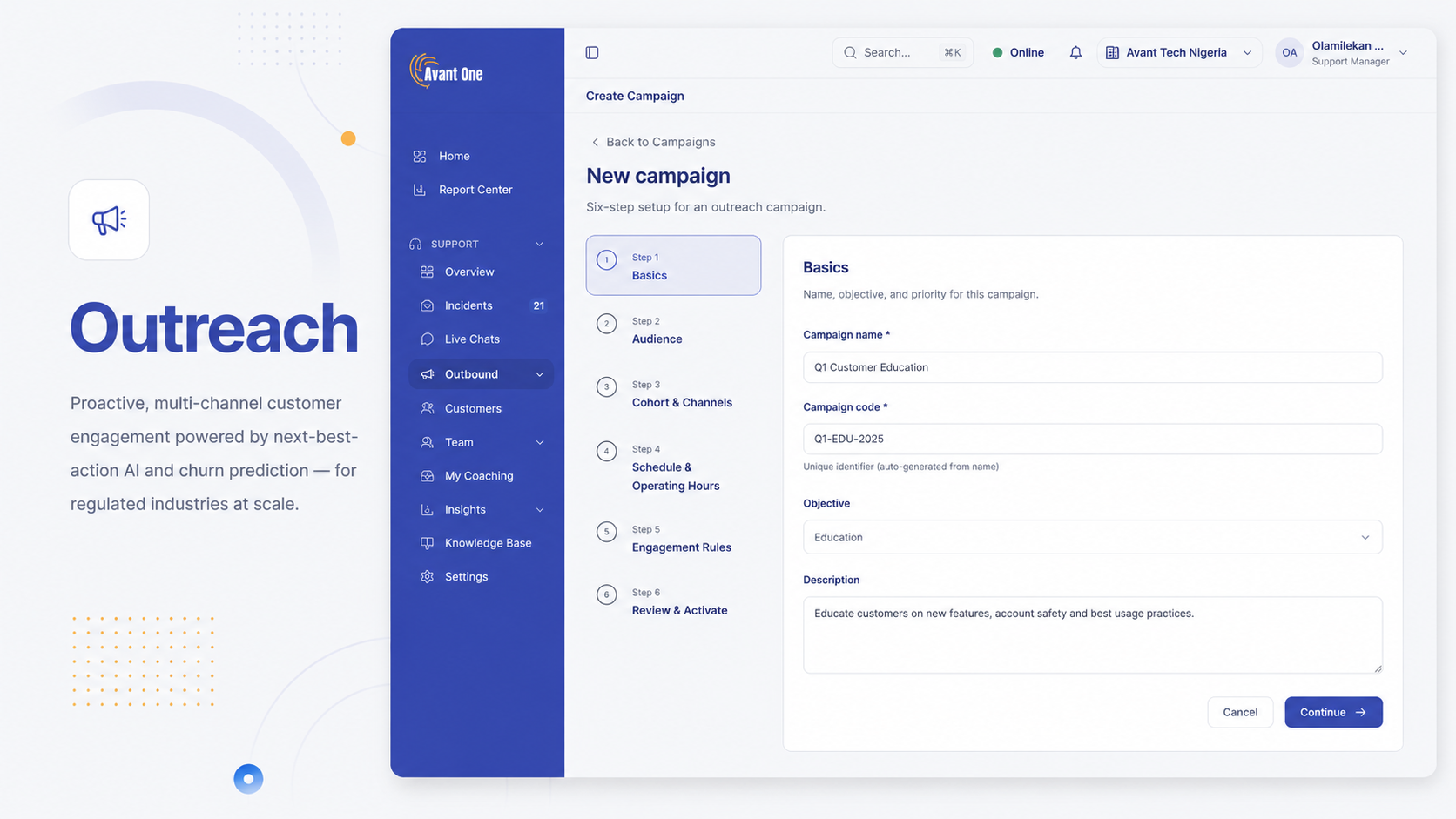
Outreach is proactive customer engagement software for teams that need to communicate at scale without separating outbound campaigns from the customer context held by service and collections operations.
Key capabilities
What teams use Outreach for
- Account and service notifications
- Fraud or security alerts that require customer action
- Payment and appointment reminders
- Onboarding and activation follow-up
- Renewal, retention and save campaigns
- Required-document or compliance follow-up
- Customer education and operational announcements
- Targeted engagement triggered by account, case or customer events
Omnichannel should mean one journey, not four outbound tools
Sending on multiple channels is useful; preserving context across those channels is more valuable. Outreach is designed so teams can coordinate customer communication and understand the response without manually reconciling separate campaign, messaging and service systems.
A customer who responds to an outreach message with a service issue can move into Incident. A repayment-oriented engagement can connect naturally to Collect. Teams can also deploy Outreach as the first use case without adopting the other modules immediately.
AI that helps prioritize the next interaction
Next-best-action AI — can recommend an appropriate message, channel and timing within configured operating rules rather than treating every customer identically.
Churn prediction — can use available service and engagement signals to identify customers who may need proactive attention, helping teams act before a relationship deteriorates.
AI-scored contact routing — can help determine when and where engagement is most likely to work, while campaign outcomes remain visible across the channels involved.
Automated QA and coaching — can score customer conversations against configured quality rubrics and provide coaching recommendations from real engagement interactions.
Why buyers consolidate proactive engagement
WhatsApp and digital channels with operational context
Use modern channels without turning them into isolated messaging silos. Responses can remain connected to the customer journey and move into a service or collections workflow where needed.
Triggered communication instead of manual follow-up
Tie outreach to meaningful events and operational workflows so teams spend less time maintaining spreadsheets and one-off reminder processes.
Customer engagement that works with regulated operations
Templates, opt-out handling, auditability and configured operating controls help organizations govern outbound communication while still moving quickly. Clients remain responsible for configuring communications in line with their applicable obligations and policies.
Start with the engagement problem you have today
A buyer may begin with WhatsApp engagement, service notifications, retention or operational reminders. Incident and Collect are additive when service resolution or collections needs to share the same context.
What AI in banking customer service actually means
For banks, fintechs and insurers, "AI in customer service" usually describes a set of capabilities layered onto existing service and engagement channels rather than a single product: conversational assistants that handle routine enquiries, models that read sentiment and urgency in a customer's message, and recommendation engines that decide the next best action for a given customer and moment.
None of these capabilities work well in isolation. A virtual assistant that cannot see a customer's case history, or a sentiment signal that never reaches the agent handling the conversation, adds noise rather than value. That's why banks increasingly evaluate AI as part of a connected customer-operations platform rather than as a standalone chatbot bolted onto a contact centre.
How is AI being used in banking?
Three use cases account for most of what banks and fintechs are deploying today.
24/7 virtual assistants. — Conversational AI answers routine account, balance, transaction-status and product questions outside contact-centre hours, then hands off to a human agent with full context when a query needs judgement. Outreach's OneIQ℠ Conversational works this way across supported channels — the objective is to resolve routine needs efficiently and make the handoff into Incident clean, rather than trap a customer in automation when they need a person.
Sentiment analysis. — Reading tone, frustration and urgency in a customer's message lets teams prioritise at-risk conversations before they escalate into a formal complaint. Outreach's AI-scored contact routing and automated QA use the same underlying signal to flag conversations that need attention and to coach agents from real interactions rather than occasional manual samples.
Next-best-action. — Rather than sending every customer the same message on the same channel, next-best-action models recommend the message, channel and timing most likely to work for a specific customer, based on account status, engagement history and configured business rules. This is the same next-best-action AI already built into Outreach's proactive-engagement workflows, described above.
Is AI replacing customer service?
Not in any deployment pattern we see at banks and fintechs today. AI is best deployed as augmentation: automating the routine share of contact volume — status checks, simple requests, first-line triage — while routing anything involving judgement, negotiation, a complaint or a regulatory-sensitive decision to a human agent with the AI-gathered context intact.
Outreach and Incident are built around that handoff rather than around full automation. Configured operating controls let a bank decide, by role and use case, where AI can act on its own and where a human must stay in the loop — which matters as much for customer trust as it does for regulatory comfort.
What is the best AI tool for banks?
There is no single "best" AI tool independent of what a bank is actually trying to fix. A virtual assistant deployed without connected case management just moves the same contact volume into a different queue; a sentiment score that never reaches an agent or a supervisor changes nothing about the outcome.
The more useful question is whether the AI capability sits inside the same customer-operations context as service, engagement and collections, so a sentiment flag, a next-best-action recommendation or an automated QA score can actually change what happens next for that customer. That's the approach Outreach and Incident take: AI features are governed by role and policy, work across WhatsApp, SMS, email and voice, and feed back into the same case and engagement history rather than living in a disconnected tool.
Certified for regulated customer engagement
Avant One is SOC 2 Type II, ISO 27001 and PCI DSS certified, with GDPR, HIPAA and NDPC (NDPA) compliance and native regulatory reporting for CBN, NAICOM and NCC. See the full breakdown on Security, Compliance & Regulatory Reporting or request our compliance documentation.
Common buyer questions
Is Outreach a marketing automation platform?
It can run campaigns, but its primary role is operational customer engagement: service notifications, reminders, required actions, retention interventions and other communications that benefit from being connected to customer operations. It is not positioned as a replacement for every advertising or marketing-automation capability.
Can Avant One support WhatsApp customer engagement?
Yes. WhatsApp is one of the engagement channels supported by the proposition, alongside SMS, email and voice. The value is not simply sending WhatsApp messages; it is connecting those interactions to the relevant customer and operational workflow.
Can we trigger outreach from our existing systems?
That is a core integration use case. Trigger patterns depend on the client's source systems, APIs, event model and security requirements.
What happens when a customer replies with a complaint or complex question?
The interaction can be routed into the appropriate human or Incident workflow with context rather than leaving the response stranded in a campaign tool.
Can Outreach be used for collections reminders?
Yes, particularly for proactive reminders and engagement. Organizations that need structured delinquency-stage collections, promise-to-pay follow-up and collections-specific controls should also evaluate Collect.
Who uses Outreach?
CX, customer operations, retention, servicing and collections-adjacent teams at banks, fintechs, insurers, telecoms and other organizations with high-volume customer communication needs.
See Outreach in action
Book a walkthrough with one of our CX platform specialists.