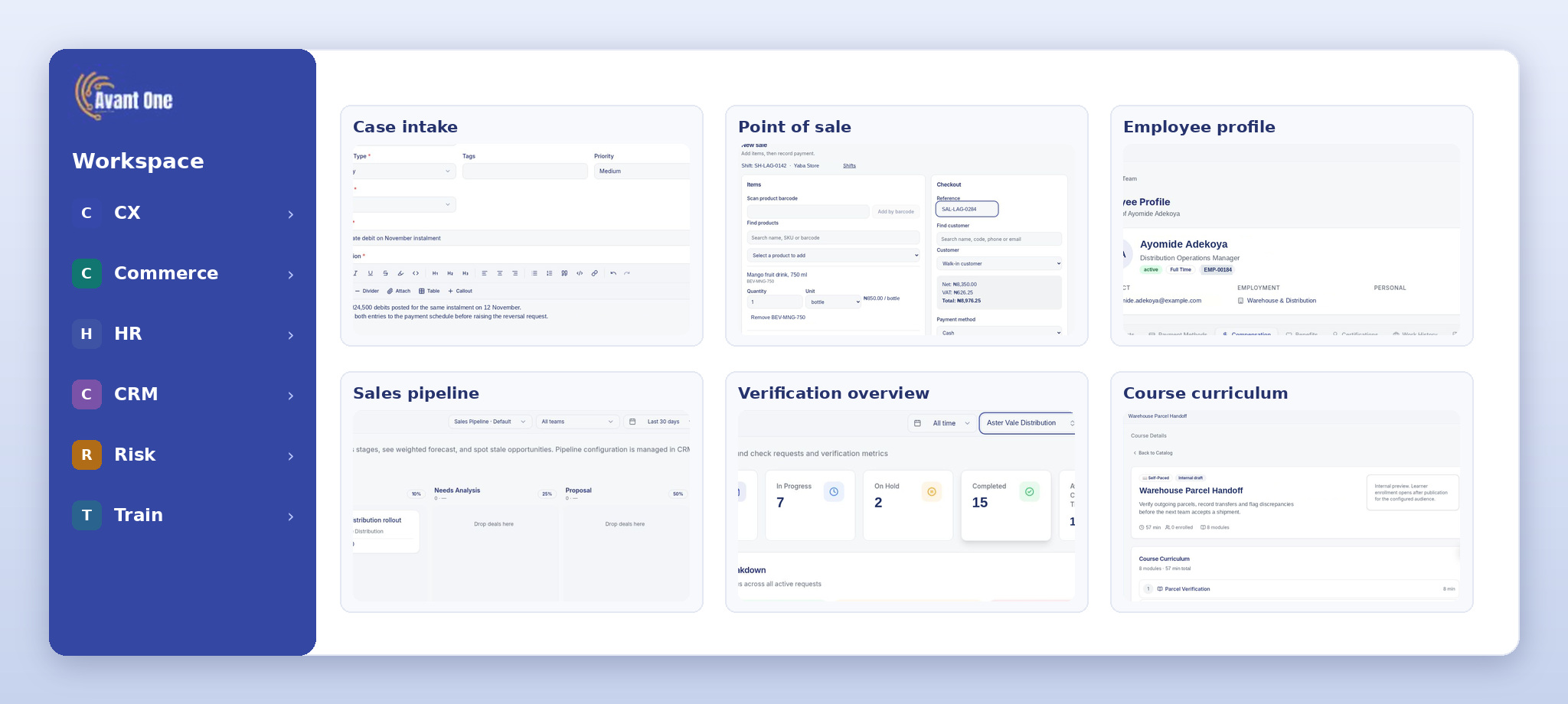
What "one platform" actually means here
Plenty of software is sold as all-in-one and turns out to be separate applications behind a shared login, each with its own customer list, its own idea of who an employee is, and its own export to reconcile at month end. The difference shows up in four places.
One record
A person or a company exists once. The candidate your recruiters sourced is the employee payroll pays. The customer support is serving is the one verification checked at onboarding. The supplier purchasing ordered from is the one finance owes. Nothing is re-keyed, and nothing drifts apart between systems.
One permission model
Access is granted per module, per role, down to individual capabilities, from one place. There is no separate admin console per product and no second set of leavers to remember to disable.
One audit trail
Who did what, when, with what data, and which automated step was involved — recorded the same way across every operation. When an examiner asks a question, the answer comes from one place rather than being assembled from four exports.
One commercial relationship
One vendor, one contract, one support desk in your timezone, one roadmap. Adding a product is a commercial conversation, not a procurement programme.
OneIQ℠ — the AI layer underneath all of it
OneIQ℠ is not a seventh product. It runs inside each of the six, on your operational data, under permissions you set.
What makes it usable in a regulated operation is that it shows its work. A candidate ranking, a lead score, a verification result, a next-best-action — each carries the factors behind it and the weighting you chose, and you can change that weighting. Every automated decision is attributable and reversible, and any capability can be switched off per feature and per role.
Integration
Avant One is API-first. REST APIs and webhooks connect it to core banking, accounting, ERP, payments, data warehouses and whatever else you already run. Products inside the platform reference each other directly, so an integration you build once is available to every operation rather than per application.
Where a system of record should stay where it is, it stays where it is. The platform is designed to take over operations, not to force a rip-and-replace before it can show value.
Security and governance
Role-based access, audit trails and configurable approval rules are standard rather than an enterprise tier. Personal data is handled in line with the Nigeria Data Protection Act.
Start with one operation
The usual pattern is one operation that hurts, proven on its own terms, then the next when the case makes itself. That is also the cheapest way to test the platform claim: run one product, add a second, and see whether the second actually cost less.
Request a demo | View pricing | Compare Avant One
Frequently asked questions
Do I have to buy the whole platform?
No. Each product works on its own and is priced on its own. Most customers start with one and add others as the case develops.
What does the second product actually save me?
The record, the permissions, the audit trail and the integrations already exist, so the second product is configuration rather than implementation. The data it needs about people, customers and products is already there.
Can Avant One replace our ERP?
It depends which parts you mean. Commerce covers inventory, purchasing, point of sale and the accounting around them; HR covers people and payroll. Where a core system should stay, Avant One integrates with it rather than replacing it.
Is AI included or an add-on?
OneIQ℠ is part of every product rather than a separate licence, so there is no AI tier to buy. Its usage is charged separately, per AI session, on top of each product's own price — and what counts as a session is defined per product line, because a support conversation, a payroll run and a verification check are not the same unit of work. You pay for the AI work you run, and nothing for capacity you do not consume.
How long does it take to get one operation running?
Growing teams can be working in a trial the same day. A larger deployment is governed by integration, migration and sign-off rather than by the software, and is scoped in the evaluation.
What happens when you add a new product?
It arrives on the platform you already run, using the same record, permissions and audit trail. There is nothing to connect and nothing new to administer.