AI customer operations built into the work, not bolted onto it
Avant One℠ applies AI inside customer service, proactive engagement and collections workflows so teams can automate routine interactions, assist agents and improve operational decisions without separating AI from the customer context and controls around the work.
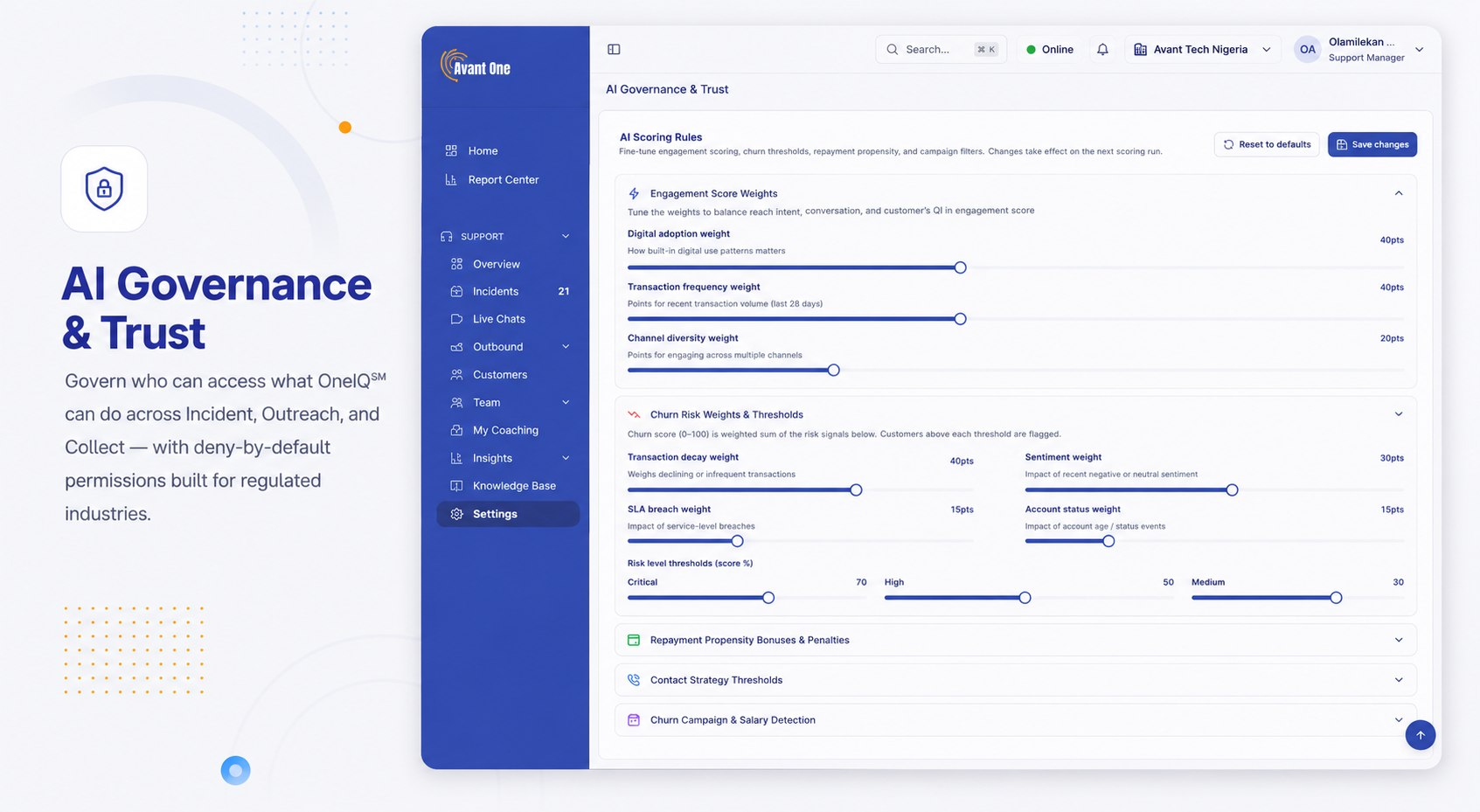
AI capabilities across the operating journey
- Conversational AI for configured customer interactions
- Agent assistance, summaries and response support
- Next-best-action recommendations
- Prioritization and routing support
- Automated quality review and coaching signals
- Knowledge assistance and recurring-question insight
A customer service chatbot that is part of the operation
Most teams searching for a chatbot for customer service want the same three things: routine questions answered at any hour, fewer repeat contacts reaching agents, and a clean route to a person when the conversation needs one. A standalone chatbot usually delivers the first and struggles with the other two, because it cannot see the customer's open cases or pass the conversation on with its context.
In Avant One℠, conversational AI is one part of the same platform your agents work in:
- Channels customers already use — conversational AI across web chat, WhatsApp, Facebook, Instagram and SMS.
- Answers grounded in your knowledge base — the self-service assistant draws on your own articles, and articles can be drafted from questions it could not answer.
- Language detection and human handoff — the conversation's language is detected automatically, and it can be handed to an agent rather than looping the customer.
- A case when the issue needs one — a chat that turns into a complaint or dispute can continue as a case with ownership, SLA tracking and an audit trail in Incident.
- Controls around what AI may do — AI permissions are deny-by-default and granted per role, AI-assisted actions are audit-logged, and higher-autonomy actions can require human approval. See AI governance.
For banks, fintechs, insurers and telcos in Nigeria, that combination matters more than the chatbot on its own: the same conversation has to stand up to complaint-handling timelines and regulatory reporting. See Avant One℠ for Nigeria.
Human judgment remains part of the operating model
AI should accelerate repeatable work while making escalation cleaner. Avant One℠ is designed so organizations can configure permissions, operating rules and human handoff around the workflows where judgment or additional control is required.
One AI layer across connected customer operations
Because Incident, Outreach and Collect can share customer context, AI recommendations do not have to start from an isolated ticket or campaign. Service history, engagement and collections activity can inform the workflow where appropriate and permitted.
AI for banks and financial institutions
Financial-services teams often need stronger controls around automation, human escalation, auditability and sensitive customer journeys. Our dedicated guide explains how conversational AI, agent assistance, routing and automated QA can be introduced without treating maximum automation as the goal.
Read the AI customer service for banks and financial services guide | See Avant One℠ for banking
Frequently asked questions
Is Avant One℠ a chatbot for customer service?
It includes one. Conversational AI handles configured customer interactions across web chat, WhatsApp, Facebook, Instagram and SMS, and it runs inside the same platform as case management, proactive engagement and collections rather than as a separate chatbot tool.
Which channels can the customer service chatbot run on?
Web chat, WhatsApp, Facebook, Instagram and SMS. Conversations from those channels can share the same customer context, so a customer who moves from web chat to WhatsApp does not have to reconstruct the history.
What happens when the chatbot cannot answer?
The conversation can be handed to a human agent with its context preserved, and a service issue can become a case with an owner and an SLA. Questions the assistant could not answer can also be used to draft new knowledge base articles.
Does adopting AI mean removing human agents?
No. AI is designed to accelerate repeatable work and support agents, not replace human judgment. Organizations configure which journeys AI can complete and where escalation to a human is required.
Can we start with one AI use case instead of automating everything at once?
Yes. Conversational AI, agent assistance, next-best-action, routing and automated QA can be introduced independently around whichever workflow creates the strongest case, rather than requiring a full rollout.
Does AI require a separate customer record from our service and engagement tools?
No. Because Incident, Outreach and Collect can share customer context, AI recommendations can draw on service history, engagement and collections activity where permitted, rather than starting from an isolated ticket.
Can we control what AI is allowed to do and when it escalates?
Yes. Permissions, operating rules and human handoff points are configurable per workflow, so automation stays within the boundaries the organization sets.
See AI against a real use case
Bring a representative support, engagement or collections workflow. We can focus the evaluation on the AI capabilities that matter, the data and integrations required, governance expectations and the outcome you need to improve.
Request an AI customer operations demo | Start a free trial | Explore AI governance | View Features